A Beginners Guide on Understanding and Using ALL THOSE ***** NUMBERS! - Getting Started - Rachio Community
Home | Support | Status Page
A Beginners Guide on Understanding and Using ALL THOSE ***** NUMBERS!
You have selected 0 posts.
12.7k views 47 likes 7 links 17 users
30](https://community.rachio.com/u/rraisley "rraisley")
17](https://community.rachio.com/u/Gerardv514 "Gerardv514")
7](https://community.rachio.com/u/Linn "Linn")
4](https://community.rachio.com/u/Chromedome "Chromedome")
3](https://community.rachio.com/u/cg2000 "cg2000")
read 24 min
Top replies
2 / 79
Jul 2020
post by rraisley on Jul 17, 2020
I started this thread to tell basically everything I’ve found out thus far, in my short experience with Rachio, in the hopes of simplifying and helping other newbies. I was going to do it all in a single post, but realized that 1) This old retired engineer is way too wordy for that, and 2) People would fall asleep before learning anything. So I’m going to separate it into topics, which I will add to this thread.
Oh, and before I start, you Pros please feel free to call me out on any and all errors or misconceptions I have; no need to confuse people more than necessary, and I can take correction. I may cry a little, but I can take it.
12.7k views 47 likes 7 links 17 users
30](https://community.rachio.com/u/rraisley "rraisley")
17](https://community.rachio.com/u/Gerardv514 "Gerardv514")
7](https://community.rachio.com/u/Linn "Linn")
4](https://community.rachio.com/u/Chromedome "Chromedome")
3](https://community.rachio.com/u/cg2000 "cg2000")
read 24 min
Top replies
post by rraisley on Jul 17, 2020
What Schedule Should I use?
Naturally, when setting up your new system, you need to do as asked, and fill in all Zone information (except maybe the Advanced page, as you may not be sure about it). Best to save the Advanced until you know a bit more (although that my not take too long).
Next, you’ll want to make 1 or more schedules. A manual schedule, except in specific circumstances, will not help much, or at least will not take advantage of your new Rachio Smart controller, so it’s out, as the main schedule. And IMHO, Flex Monthly is out too, at least for the majority of your zones, because it will water ALL zones in the schedule on the same day. No one seems to mention that, but that alone is enough to turn me off; it just takes too much time to always water all your zones on the same day. While if you make a Flex Monthly schedule, you’ll find that out, I doubt most people know that up front.
So, Flex Daily it is. And very quickly, after entering your zones and answering the schedule questions, there you have it you’re (maybe) done. But I had a LOT of questions.
How Much Water per Week Will Be Applied?
I knew this with my old system, but had no idea with this. And why are the times so long? So confusing? It’s watering, but so much more or less than my old system. I added up daily times, and tried to calculate water flow, and ended up with different answers ever time I did it.
It turns out that finding out how much water your Rachio controller will provide each zone per day or per week is a snap: Click on any zone, then click on the Moisture %. It shows the Field Capacity graph; below it is a table (on a phone app, click More Detail to see the table. See the numbers in the Crop Evapotranspiration row? That is how much water Rachio wants your lawn to have each day. Either from rain or from irrigation. Right now, mine vary between 0.18” and 0.21” of water each day of this week. Adding them up for the current week, it gives 1.36” of water, in my case. That’s it, that’s how much water Rachio will give my lawn (assuming no rain). This week, at least on average. As temperature, humidity, etc. vary through the year, those values will change, watering less during cooler times, more during warmer times.
Where does that number come from? How is it changed? How is it calculated? Well, of all the variables within Rachio that you can change (and as you know, there are a bunch, and with all the explanations of “do this for more/less water/minutes/frequency/etc.”, there are only two things that change the water per week: Exposure (amount of sun), and Crop Coefficient (a default for which is set when you select your grass or crop type), each settable per zone. The final part of the puzzle is the (unseen) ET or evapotranspiration, which Rachio calculates each day based on previous, current and future temperature, humidity, etc. in your area of the world. And you can’t change that. Mind you, NOTHING else in the program determines inches of water per week (except Nozzle Flow Rate, but changing that should only be done with facts, not guessing, and will be discussed later). Not soil type, or depth, or slope, or any of those other fancy numbers. Shadier areas can decrease the water by 10-30%, but let’s consider sunny areas: Rachio will take it’s calculated ET value for each day and multiply that by the Crop Coefficient (mine’s 0.85), and it’s done. If the ET is 0.24", multiply that by .85, giving about 0.20” per day. Or about 1.4” per week. If your Crop Coefficient is only 0.65, it won’t need as much water, so Rachio would put down 0.24 x 0.65 = about .16” per day or closer to 1.12” per week.
Why do we care about this? Well, first, you can easily compare it to any previous system you used, if you know the inches of water applied. Second, you don’t need to change anything else to change your inches of water applied per week, should you want to. While the estimated Crop Coefficient for your grass might be right on, it also might be too low or too high (Warm Season grass is input by Rachio as 0.65, but research indicated that my Centipede grass should be 0.85). You can easily adjust the total water per week just by changing it. If your current values add up to 1” water per week, and you think it should be 1.2”, just increase the Crop Coefficient by 20%. Done!
How do I know it needs to be higher or lower? Watch your grass. If, over weeks (not days) it dries out too much or gets crispy, it needs more water. If it (almost) constantly stays soggy, it needs less water. 1” isn’t a bad value to start with, but it’s low for most of the country in the summer. Start with Rachio’s suggestion, but if needed, make the change to Crop Coefficient to increase or decrease it.
post by rraisley on Jul 17, 2020
What About Nozzle Inches?
I know some of you will immediately say that to modify how much water your zone gets, you change Nozzle Inches per Hour on the Advanced screen of each zone. Yes, that will do it too. But I really don’t like it. First, while Nozzle Inches per Hour is on the Advanced screen, I kind of hate that it is. It is probably the most important number in determining how much water your lawn actually gets, and how healthy it stays. When you select your Spray Head type, it chooses the Nozzle Inches and Efficiency for you. Probably a good starting point. But at least in my case, many of these are off by a factor of 2! They just don’t know how good (or poor) a job your irrigation contractor did when setting up your system.
There are basically two ways of confirming, or changing, the value of each zone, both probably more than 80% (90%?) of people with irrigation systems do: 1) Calculate the area of each zone and measure the gallons or cubic feet of water applied to it in X minutes, then do a bunch of calculations to determine the average inches per hour (I had a spreadsheet, but them I’m an, uh, engineer). 2) The low tech, more time consuming, but far more accurate way of putting catch cups around each zone to measure actual, real, applied water for a given time. I’ve got the cups, now to do the work (it’s just been too darn hot here). If you really care about your lawn/crops, you really need to measure the water applied for a given length of time, for any system to accurately apply the correct water quantity. That’s just #1.
And since it is so difficult, or time consuming, or exhausting, to get those values for each zone, that’s why I don’t like to modify them. You sweated it out to get the values: USE THEM! If you’ve never done either of these to determine actual Nozzle Inches per Hour, sure, feel free to modify it up or down to change things, but as soon as you can, measure them. Then you have a definite value to use you are sure of, and as posted originally, go back to using Crop Coefficient if you want to apply more or less water to your lawn.
post by milehiguy on Jul 18, 2020
Interesting read Richard! Will def. revisit when I finally take the plunge from Fixed to Flex. Thanks for taking the time to write this up. - from a (fairly) old retired programmer.
post by rraisley on Jul 18, 2020
How Much Water is Being Applied at One Time, or ‘Why am I watering the street when I don’t own it?”
It was surprising to me, at first, to find out that the total water applied by irrigation per week does not vary with root depth and soil type, as explained previously. Well, where do those come in? The main answer is: The amount of water applied at one time, or rather on one day, in each zone.
First, why do we care? If we give the lawn the 1.4” or whatever water per week it requires, does it really matter how much water is applied at any one time? Yes, it does, for the health of your lawn, in particular its ability to withstand hot weather. If we apply that 1.4” by watering just a bit per day, in this example 0.2”, we keep moisture in the top layer of the lawn, but never really water deep enough for the roots to grow, thus protecting the lawn and making it healthier. Watering every day is just bad for your lawn. Basically, every time you water, you should water enough to soak into the lower roots of the lawn, or at least where you’d like them to grow to.
Watering too much at a time is bad as well: Water will no doubt be wasted, either by running off, or sitting in puddles which can actually kill the grass. So how much is right? Rachio uses the Field Capacity model for watering, explaining with their Bank and Gas Tank analogies. I’ll use a bucket. You want to fill the bucket to the top, which will water to the bottom of the bucket (roots). The water then evaporates daily from the bucket until it reaches about the halfway point (an Allowed Depletion of 50%). If you let the water level get too low, it will stress your lawn, not providing enough water to the roots. If it’s too high, you overflow the bucket.
In our case, the bucket isn’t really empty; it’s filled with your soil, and different soils can hold different amounts of water. That’s the soil’s Available Water, which generally varies from 0.05 to 0.21, in my case 0.17. How much water, in inches, will your soil hold? That’s easy. For 8” deep roots it’s:
Inches of water held = AW x Root Depth = 0.17 x 8 = 1.36” of water
While the soil holds that much water, we don’t want to apply it all at once, because 1) we’d probably over-water, as it couldn’t accept it all at once, and 2) we don’t want the water in the bucket to ever be “empty”, or your grass will be on the point of dying. Rachio suggests a AD of 50%, which means we’ll wait until half the water is gone. That amount of water is:
Inches of water held = AWC x Root Depth x MAD = 0.17 x 8 x .50 = 0.68” of water
That value of represents the amount of water that Rachio will apply every time it waters, unless it reduces it due to rainfall, and answers the question we started with. It’s trying to top up the bucket every time it waters, then waits until the bucket is half full before watering again.
Once again, there are surprisingly few variables that affect the water applied at one time: the Available Water (determined by your soil type), the Root Depth (determined by your grass or crop) and the Allowed Depletion (you get to choose that one, but it should probably stay not far from 50%). If you want to water less often, you can decrease the Allowed Depletion some; if you want to water more often, you can increase it some, but watch that you don’t overflow your bucket and waste water in the street.
Note that changing these variables will change the amount of water applied in one day, and also the total amount that Rachio thinks your soil will hold, but it will NOT change the total water, on average, that your lawn receives. That is done only by the Crop Coefficient, as explained in the first post above.
Also note that while the amount calculated here will be applied each day Rachio waters that zone, it may not be all applied at once. Letting Smart Soak do its job will let the system break the 0.68” up into 2 or more separate applications with soak times between, totaling 0.68”, but allowing your yard time to soak it up. This is often necessary for soils such as clay, which hold a lot of water but absorb it very slowly, and for sloped yards, which let the water run off if too heavy.
post by rraisley on Jul 18, 2020
How Often Will Rachio Water My Lawn?
Everyone wants to know how often their system will water. Usually because they have experience in programming a less-automated system previously, and want to know how it compares. As mentioned earlier, Rachio’s Flex Daily uses the Field Capacity method with a specified Allowed Depletion. And as stated previously, it will always water the full amount calculated previously (unless rain occurs) each time, then wait until the Crop Evapotranspiration value indicates it’s time to water. On average, the system will water every:
Days Between Watering = Total Water Applied / Daily Crop Evapotranspiration Value
We calculated the Total Water Applied in the previous post; it was 0.68” for the example given. Your value, without calculating, will simply be the highest Irrigation value in the chart for each zone over several weeks. The amount watered can vary due to actual or anticipated rain, but the maximum amount will always be the same.
The Daily Crop Evapotranspiration value varies with each day. In the previous example, it was running about 0.20” per day. So in this case:
Days Between Watering = 0.68” / 0.20” = 3.4 days
The system will water about every 3.4 days, or just about twice a week. As mentioned in the first post above, the amount of water used per week varies with temperature, humidity, time of year, etc. In our case, it does this by changing the water used by your lawn per day, the Daily Crop Evapotranspiration. When the weather cools down, this value will be lower, and therefore the time between watering will change as well. When the daily water use lowers from 0.20 to 0.12, for example, days between watering would change to:
Days Between Watering = 0.68” / 0.12” = 5.67 days
In operation, Rachio always waters the same amount at one time, then waits a varying number of days until the soil nears the depletion value, then waters to fill the bucket up again.
Should you want to change this, you have to change the Total Water Applied at one time (since you can’t change the temperature). Assuming you’ve entered your values correctly, this means changing the Allowed Depletion (from 50%), or possibly Root Depth. In my case, the average value of Root Depth for Warm Season Grasses was 9.84”, but I have Centipede grass, which I found has shallow roots, only 6-8”, so changed it accordingly.
You probably shouldn’t change these values much; Rachio has a reason for wanting to soak your lawn well, then let the top part dry out (the Allowed Depletion); this brings oxygen to the roots and helps the lawn in many ways. But you can adjust it slightly if desired.
post by Steve_Idaho on Jul 23, 2020
@rraisley Richard, thanks for putting this together. I was looking for something like this from Rachio but was quite surprised to not find it. This is very helpful for getting my new Rachio controller working properly.
Coming from conventional controllers (Hunter, Rainbird) with fixed schedules and seasonal adjustments (solar and rain adjustment on the Hunter X-Core), it takes some getting used to the idea of trusting the system to optimize watering.
We bought a house with a highly irregular yard. I’m working to improve the Hunter PGP rotor locations, rotor sweep angles, individual rotor nozzle flow rates, and zone run times for a healthy lawn with reduced water use. We have a lot of forest shade at different times of the day and seasons, so we are prone to moss growing in the grass here in the Inland Northwest. That is especially true if we over-water. So optimizing the system for healthy turf, minimal moss, avoiding boggy spots, etc is a real challenge.
Thanks again for taking the time to put your documents together. You are doing Rachio’s job for them.
Question…is there a way to export the History data? The History information available in the mobile app is good, but it would be nice to see the run time of all the zones in a single Excel table.
post by rraisley on Jul 23, 2020
Not really, but thanks. They do a good job of explaining each variable, but I didn’t always understand what the results were. With Flex Daily, it all comes down to 1) How much water is applied at a time, and 2) On average, how much water will be applied per week.
Ah, a fellow Excel-ent person! I looked, but don’t see it. I entered all my run times into an Excel spreadsheet too, then graphed how much water is applied for each day, and doing that helped me understand how it worked. But now that I know, I don’t feel the need to do that.
I can’t emphasize enough, though, that real Nozzle Inches per Hour is so very important. Many people misunderstand what this number even represents, and based on my yard at least, the values given are not at all representative. My son’s going to help me get catch cup readings this weekend, and then I’ll probably end up changing everything!
BTW, does anyone know how to have multiple quoted areas within a post? The normal [quote]Text[/quote] doesn’t seem to work. It wants to quote from the first to the last, along with everything in between.
post by Alturia on Jul 23, 2020
If you want to quote a subset of a post just highlight the section you want to quote and then select the quote button when it appears. Then if you want to quote another area go back and highlight the second area.
Here’s the 2nd quote for example.
post by Steve_Idaho on Jul 23, 2020
rraisley](https://community.rachio.com/t/a-beginners-guide-on-understanding-and-using-all-those-numbers/26539 "Load parent post")
Thanks for the quick reply. I bought a couple of boxes of catch cups a couple years ago and haven’t used them yet. I need to draw a decent map of the yard and put the cups out – hopefully in the next couple weeks.
Real Nozzle Inches per Hour is tough because I’ve got some rotors going 360 degrees, some going 180, some doing 90 degrees. I have different size nozzles in each rotor depending on the sweep and water requirements of that part of the yard (the shaded areas need less water, the bright sun areas need more). I figure I’ll use the catch cups to collect a number of data points per zone to get an overall estimate of inches per hour over the entire zone, then divide by the number of nozzles (rotors) to get an average inches per hour per nozzle rate.
post by Steve_Idaho on Jul 23, 2020
rraisley](https://community.rachio.com/t/a-beginners-guide-on-understanding-and-using-all-those-numbers/26539 "Load parent post")
@rraisley – Repeating my reply, this time using “@”…
post by rraisley on Jul 23, 2020
Testing
Then if you want to quote another area go back and highlight the second area.
Weird. Works, but weird. Turns out my method works too, using [quote] and [/quote] but only if those are on their own line. Same with the “>” you used. Different, but now I know. Thanks.
post by Sweetrexwood on Jul 23, 2020
rraisley](https://community.rachio.com/t/a-beginners-guide-on-understanding-and-using-all-those-numbers/26539 "Load parent post")
Can you have more than one Flex Dailey schedule? I have my cold weather grasses on Flex Dailey and the areas with more shrubs than grass on Monthly. I seems I would be better putting them on a Flex Dailey too.
I very much enjoyed the information you shared.
post by rraisley on Jul 23, 2020
Right there is something that I think the terminology is all messed up on. Nozzle Inches per Hour does NOT mean how much water is produced by each nozzle (as it says). It means how much water is applied to your lawn (by the nozzles). For Rachio to ask how much water each nozzle puts out, it would then need to know the area each nozzle waters, and as you say, 360/180/90 degrees. I very much dislike that terminology. A recent long post complaining about the complexity mentioned that we should just put in the type of nozzle we have, and Rachio would use it. But again, that’s not the meaning. (And even if it were, most nozzles can be “throttled” to put out more or less water, to determine the distance the water travels.)
IMHO, Nozzle Inches per Hour should be called “Inches of Water Applied per Hour”. There are two ways of doing that: 1) Measure actual water used for a given period of time, measure the square feet covered, and calculate the average inches per hour - that’s what I’ve done so far. 2) Use catch cups for a given time to calculate average inches per hour and Efficiency. More time consuming, but MUCH more accurate.
If you’re interested, I’ve made a spreadsheet specifically for using 12 of the Orbit catch cups, which calculates average water inches per hour (to input into “Nozzle inches per hour” in Rachio) and Efficiency. Apparently I can’t upload an Excel file here, but if you PM me your email, I’ll send it to you.
post by rraisley on Jul 23, 2020
You can only have one Flex Daily schedule for any given Zone. So you can put the zones with the cold weather grasses can be on one Flex Daily zone, and your shrubs on another Flex Daily zone.
I see NOTHING difficult or complex about the Flex Daily zone once you know how it operates. I wouldn’t use anything else, because only Flex Daily takes into account the actual weather conditions you’re having.
post by Sweetrexwood on Jul 23, 2020
Thank You.
Your response is very much appreciated.
post by Linn on Jul 23, 2020
I couldn’t agree with you more!!! It make take a little time and effort to learn it, but its worth every minute that you put into it.
post by rraisley on Jul 23, 2020
1
I was wrong; there IS a download to CSV available. It’s only for each zone, so go to your Zone, scroll down below July Usage to date, and you’ll see a Download arrow. Clicking it gives you that zone’s Date, Hours usage, Gallons Usage, and Savings data. IMHO, only the Hours Usage means anything, unless you’ve properly calibrated both your “Nozzle” inches per hour and your Square Feet area, or if you’re using a Flow meter. But I think Hours Usage is what you want anyhow. Repeat that for each zone, placing each in a separate Excel column, and you can get a month’s data for each zone.
From the Home screen (I’m talking about the web screens here, but that’s where you’d usually download to Excel), there’s also a Download button. It downloads the TOTAL times and water usage, but does not separate by zone, so would be less useful IMHO. But it’s there.
post by rraisley on Jul 23, 2020
IMHO, Flex Monthly is no less difficult. ALL of the same Zone variables are in effect with Monthly. It still takes into account the Advanced variables of Available Water, Root Depth and Allowed Depletion to determine how much to water at once time, modified somewhat by the Crop Coefficient and average ET values for the month to usually water every X days, which can change the watering time as well. And it appears that it does not take into account daily rainfall, at least not in a very accurate way. And it gives you none of the valuable (to me) information about soil moisture or depletion. And it does not account for hotter or cooler than normal weather, as it uses average, historic values. I’m sure it does a fine job on average, but with all the variables meaning just as much, I like seeing what’s going on with my zones.
post by Linn on Jul 23, 2020
1
Way back in April of 2016, Rachio was really pushing all of it’s users to not use Flex (which is now Flex Daily), and to use As Needed (which is now Flex Monthly). There was a BIG backlash on the community, as the Flex users at the time saw it’s benefits and absolutely did NOT want to be forced into using what is now Flex Monthly. Rachio listened (one of the reasons I REALLY like Rachio), made some changes, and Flex Daily was born.
I don’t really understand why people want to use Flex Monthly for it’s “predictability”. I’m pretty sure it’s all based on historical data. Definitely not current data of what is happening this week. Just doesn’t make sense to me, as some years are droughts, and some years it rains every afternoon.
And you are right, the set up is exactly the same. But because it’s “predictable”, maybe the tweakings of the settings don’t make as much difference anyway, because your’e not really basing your watering on current conditions.
And Flex Monthly waters all zones in the schedule when it waters. So if I group all my grass zones together, it will get watered based on the needs of the most sensitive zone. So it would NOT take into account that my front yard is in full sun and dries out very quickly, that I have an area under trees that needs a little more water applied, and that my backyard is in the shade, doesn’t drain, and can easily become a swamp. It would make a mess of my yard.
OK, off my soapbox. Guess you can tell that I’m NOT a fan of Flex Monthly in the least. Set it up right, and Flex Daily works great. Gives my yard the water it needs WHEN it’s needed.
20 days later
post by mgliss on Aug 12, 2020
rraisley](https://community.rachio.com/t/a-beginners-guide-on-understanding-and-using-all-those-numbers/26539 "Load parent post")
“If you’re interested, I’ve made a spreadsheet specifically for using 12 of the Orbit catch cups, which calculates average water inches per hour (to input into “Nozzle inches per hour” in Rachio) and Efficiency. Apparently I can’t upload an Excel file here, but if you PM me your email, I’ll send it to you”
Thnaks for all yore great info!
post by Joblaloc8 on Aug 17, 2020
1
rraisley](https://community.rachio.com/t/a-beginners-guide-on-understanding-and-using-all-those-numbers/26539 "Load parent post")
@rraisley Great stuff posted here, thank you! I don’t see moisture % under my zones. Can you provide a screenshot?
Update: I found an image on another post, my app does not show moisture % under each zone. Version 4.1.13.
post by Linn on Aug 17, 2020
Are the zones in a Flex Daily schedule? I believe that is the only place they show. I know they definitely don’t show for a Fixed Schedule.
post by Joblaloc8 on Aug 17, 2020
Thank you! I was only flex monthly, hence why I could not see it. After switching to flex daily it is there.
10 months later
post by cg2000 on Jun 5, 2021
How can I adjust the zone parameters to make it water the same volume of water over a given period but in shorter, more frequent bursts?
post by rraisley on Jun 5, 2021
2
Reduce the Allowed Depletion. That reduces the amount of water applied at one time, which will make it water more frequently. It doesn’t affect anything else, and is easily changed back if desired.
post by turbojr74 on Jun 7, 2021
Thanks for this info @rraisley. You’ve done a great job explaining most of what is needed in terms of grass. Although I still falter in some of the calcs when using your examples with grass (this could be because I have not tried the cup measurement just yet and maybe the rotary nozzle of 0.7in is not on par).
Quick example - I live in the PNW and in order for my lawn to get .96" per week in Flex daily I’ve had to set crop coe to 118%. That will put watering that will vary between 0.09 to 0.2 each day. Soil type is sandy loam, some shade, cool season grass with slope being flat.
However I digress - my frustration with the system is I only have one zone for grass (high pressure) and 3 others for drip (low pressure). The drip is made up of Trees/Shrubs/annuals. When I first put this system together with a different controller, I used drippers/emitters to try and regulate the amount of water with a dumb controller (Trees get multiple 1 or 2gal, shrubs got a single 1gal or a couple .5gal, and other ground cover and annuals got a single .5gal).
That controller failed and I needed another and thought I would step into the future…got the R3.
This system is a bit difficult to have a zone that contains all different types of plants and water effectively (Tree/Shrubs/annuals). You get to pick one and it feels as though the premise is to keep these ALL separate (Tree/Shrubs/annuals) because of varying root depths and watering needs. I agree watering deeply for the trees, but if I set the zone for trees, that only waters a few times a month, which will kill off or neglect the others plants (shrubs/annuals) in the same zone.
If I understand correctly, it seems like one would then need 3 different low pressure zones just in one area all running next to each other to keep the plants separate and on different watering schedules. Not to mention the need to run those 3 in each area (Front/Back, other) or have super long pipe runs to stay with that running thought of keeping all same plants in a zone (pipe that goes to only trees; 4 in front and 2 in back and1 to either side of yard)…which doesn’t include a cornucopia of 1/2" to 1/4" irrigation pipe from each zone to deliver said water.
Unless someone out there does all their landscaping with each plant type grouped all in a distinct area it feels like an impossible task to set this up proper or is going to do all that extra pipe work (all that extra pipe I do not think would be feasible).
I believe I might have to come to terms that this system is not for anyone who had a legacy system with low pressure zones with all kinds of plants throughout…OR I am just missing the thought process to setting up the system to water the trees deeply, but still keep the surrounding vegetation watered often enough for their needs.
How would one get this system to work correctly and properly water enough for each?
I’m sure I’m missing the big picture and just need to be schooled on this.
post by rraisley on Jun 8, 2021
Thanks. And yeah, I’m by far most familiar with grass.
No, I think ALL systems are VERY difficult to work with a zone containing differing plants. It’s not Rachio, or any other system, it’s the fact that it is impossible to water in the most correct way for trees, shrubs, flowers and lawn with the same system. Trees can go weeks or longer without water, but drain water from everything around them. Most shrubs can go a week or more, while some flowers wilt if they don’t receive water every day. Lawns do best watered about twice a week, but even without other crops in the area, soils limit how much water can be applied at once, often requiring watering more often. It can be a royal pain, and one without a simple answer.
Also, as to water needs, I have found that lawns typically require the most water week over week, as more deeply-rooted crops can get more water from the deeper roots. So, most of the time it’s pretty safe to use the lawn to determine watering needs. Shrubs and trees in the same zone won’t need watered as often, but usually won’t be harmed the excessive water. And with large trees in the same area, it’s just often necessary to water more overall, due to the water sucked away by them.
Flowers are a different case, and can require daily water even if the grass doesn’t. And while my best friend waters his lawn twice a day, every day, and swears by it (even though it’s not recommended, his lawn does look good), if you don’t want to do that, an alternative is to water the lawn normally with Flex Daily, and then set a Fixed program to give the same zone (but meant for the flowers) 2-3 minutes of water in the middle of the day, every day. That may not be efficient, but it helps my wife’s butterfly garden survive SC summer sun. And Flex Daily considers that extra water in its calculations for the zone as well.
In a perfect world, we would have all our landscaping planned beforehand, and perfectly, expertly, irrigated for each type of plant, and that would never change. But in the real world of cheap home-builders, less-than-professional irrigation contractors, DIYers who should stick to watching TV and wives who want constant landscaping changes, we’ll all just have to live with this the best we can. Which will always be a compromise.
post by Chromedome on Jun 8, 2021
I apologize if I should start a new thread but it seems you guys will know the answer to this. I’ll keep it brief.
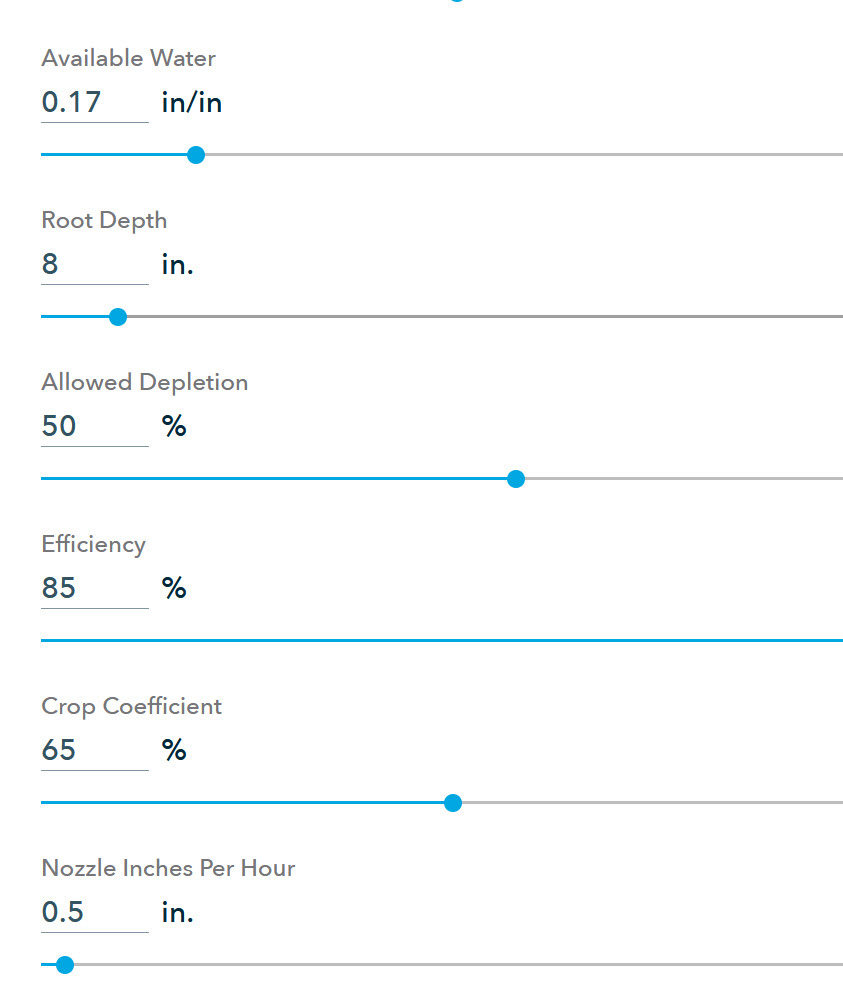
I use Flex Daily. It was explained above that nozzle inches per hour should represent real world output and not factory specs. I have MP Rotators that are spec’d for .4 in/hr. I ran some catch cup tests and found I get .5 in/hr. I did buy 10 catch cups to to the efficiency test but haven’t gotten around to that yet. My question is, it seems that the efficiency must be quite high to have a measured output higher then spec’d (good overlapping coverage). Also, just judging by my eye, the system distributes water very evenly. I had a top notch small business install my system and they did a great job.
In summary, what should I set my efficiency to for now? I had it at 85%.
Sorry, one other thing. You mention above an average root depth of 9.84 inches for summer grass. That’s the highest I’ve seen. I live in Phoenix, have a drought tolerant sod called BOBsod (Bank One Ballpark sod) and my goal is to have a green lawn but conserve water. So, I want deep roots and am using Rachio Thrive.
TIA!
Here are my current settings.
\ rachio843×989 60.7 KB](https://community.rachio.com/uploads/db1097/original/2X/f/f9d11b276aed999120d8a50af781399f15a23fe7.jpeg "rachio")
post by rraisley on Jun 8, 2021
Great that your business did a great job. You mention catch cups, but that you didn’t use them, so how did you calculate your value of 0.5 in/hr? Possibly by meter flow and area?
It is possible your rotators are putting out more water than the spec says, but it wouldn’t be due to efficiency (which can never exceed 100%), but possibly higher pressure or closer spacing than the 0.4 "/hr is based on. The catch cups can give you both flow and efficiency, but IMHO their location during the test is so critical so as to make the results inaccurate. Especially with only 10 cups.
That’s probably not a bad value for a well-installed system. All it does is increase the total water some, to help out areas that get less water. It increases it by 1/(0.4+0.6xEff) or in your case about 10%.
I would ask the suppliers of BOBsod for the values. My Centipede is a summer grass too, but only has 6" root depth and a Crop Coefficient of 85%, so requires less water at once, but more over time, than Rachio’s “Warm Season” Grass.
Here are my current settings.
[/quote]
Your settings look good to me.
post by Chromedome on Jun 8, 2021
Thanks! I meant I did a small set of tests with 3 tuna cans, two tests, one a half hour then decided to move them again and just did a full hour. The lawn needed to be watered anyway. Came up with .5 inches per hour. I thought of this just as a inches per hour test, as opposed the the DU test.
So, my lawn is about 2,200 sq ft, I’m thinking the package of 10 catch cups should be good enough to determine DU. No? I bought these: https://amzn.to/3x7zvwx
I’ll ask them about the roots.
post by cg2000 on Jun 8, 2021
rraisley](https://community.rachio.com/t/a-beginners-guide-on-understanding-and-using-all-those-numbers/26539 "Load parent post")
OK, thank you.
Could you help me understand the “Soil Moisture” graphs on the zones. I’ve set the Allowed Depletion to 35% (I assume this means the depletion will run from 100% down to 65%). However, the soil moisture graph goes down to 23% before it waters. How are soil moisture and allowed depletion related?
post by Gerardv514 on Jun 8, 2021
My flex daily schedule seems too be watering too much lately, especially Since having a lot of rain. It was set to water 4 times next week. I added up the irrigation and precipitation numbers and it was well over 2-2.5 of water.
My nozzle inches I’ve set at .8 , duration times haven’t been touch but they sit around 25ish mins of run time. It’s as if the soil moisture readings are drying evaporating very quickly even tho my ground is wet, so I looked at crop coefficient and efficiency. When I first started I remember the default for cool season grass being 80% efficient and 70% coefficient (or maybe vice verse). This was for rotor heads.
When I click zone default efficiency is at 70%, and coefficient is 78%. Is this the correct default? When I put the settings on 80/70…I see that it doesn’t water as much. I’ve tried deleting the schedule out, defaulting all the zones and only adjusted the nozzle inches to .8.
post by rraisley on Jun 8, 2021
They’ll be fine. I just think that placement of cups is critical, at least in my uneven yard, and can get confusing. The more the better, but you can even do multiple tests, like you did with the tuna cans.
post by rraisley on Jun 8, 2021
It is confusing. You are correct, that 35% Depletion means soil moisture can go from 100% down to 65%. But in looking at the charts and graphs with Rachio Flex Daily, here 0% means it’s down to 0% of the Allowed Depletion value (or is at 65%). So while actual moisture goes from 100% to 65%, indicated moisture on this graph will go from 100% to 0%. It’s done that way by other sources than Rachio, so I guess it’s a standard, but it just makes it confusing.
post by rraisley on Jun 8, 2021
1
Did it still show watering to occur after the rain? Just because it /would/ water doesn’t mean it /will/, unless the soil dries out enough.
Those seem reasonable.
The efficiency is based on the average for the type of head. The Crop Coefficient is based on the crop, or grass, type.
The Crop coefficient will vary with the type of grass. Plus, I don’t think some of the categories are specific enough. For example, Warm Season grass results in defaults of 9.84" for Root Depth, and 65% for Crop Coefficient, while my warm season Centipede grass is specified as having 6" root depth and 85" Crop Coefficient. Use the Rachio default, unless you can find more accurate information for your specific grass type.
post by Gerardv514 on Jun 8, 2021
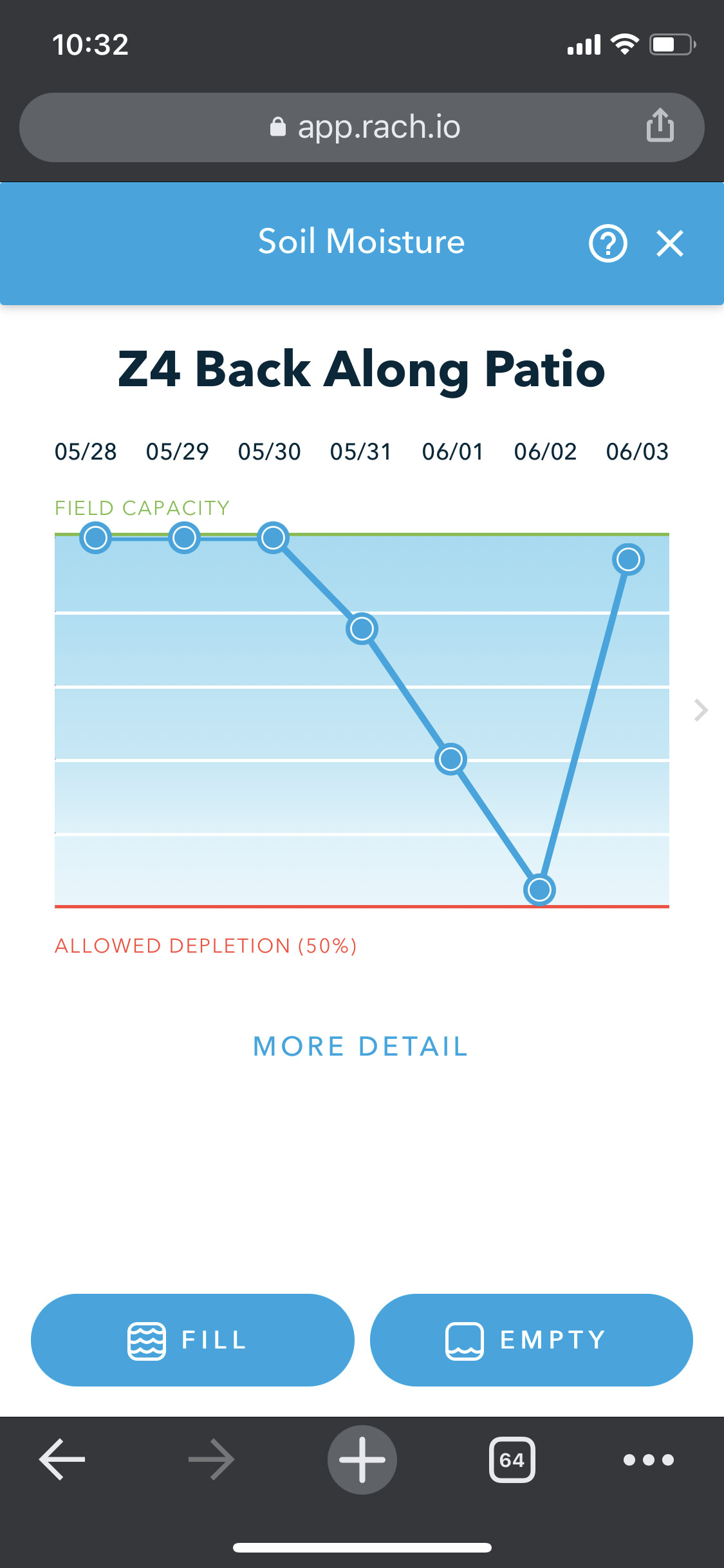
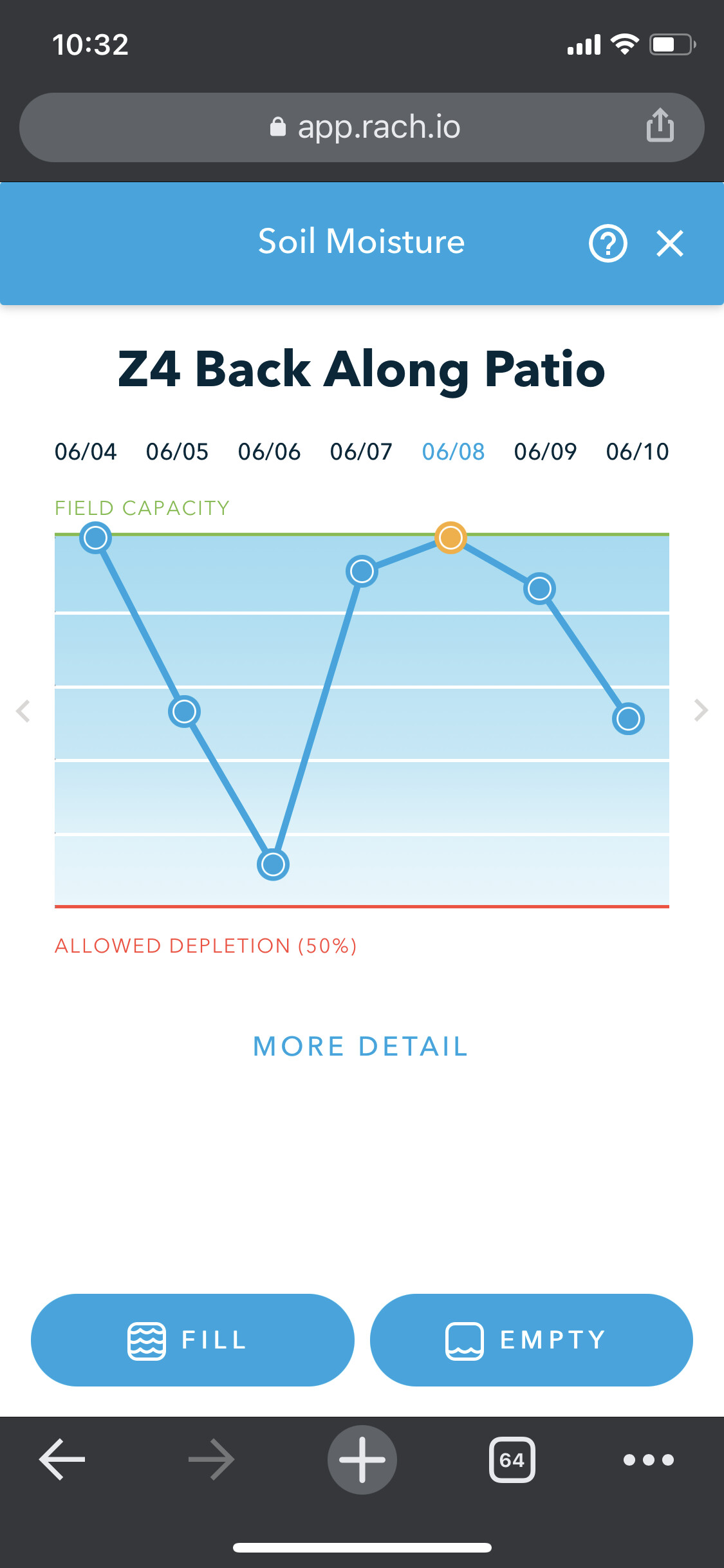
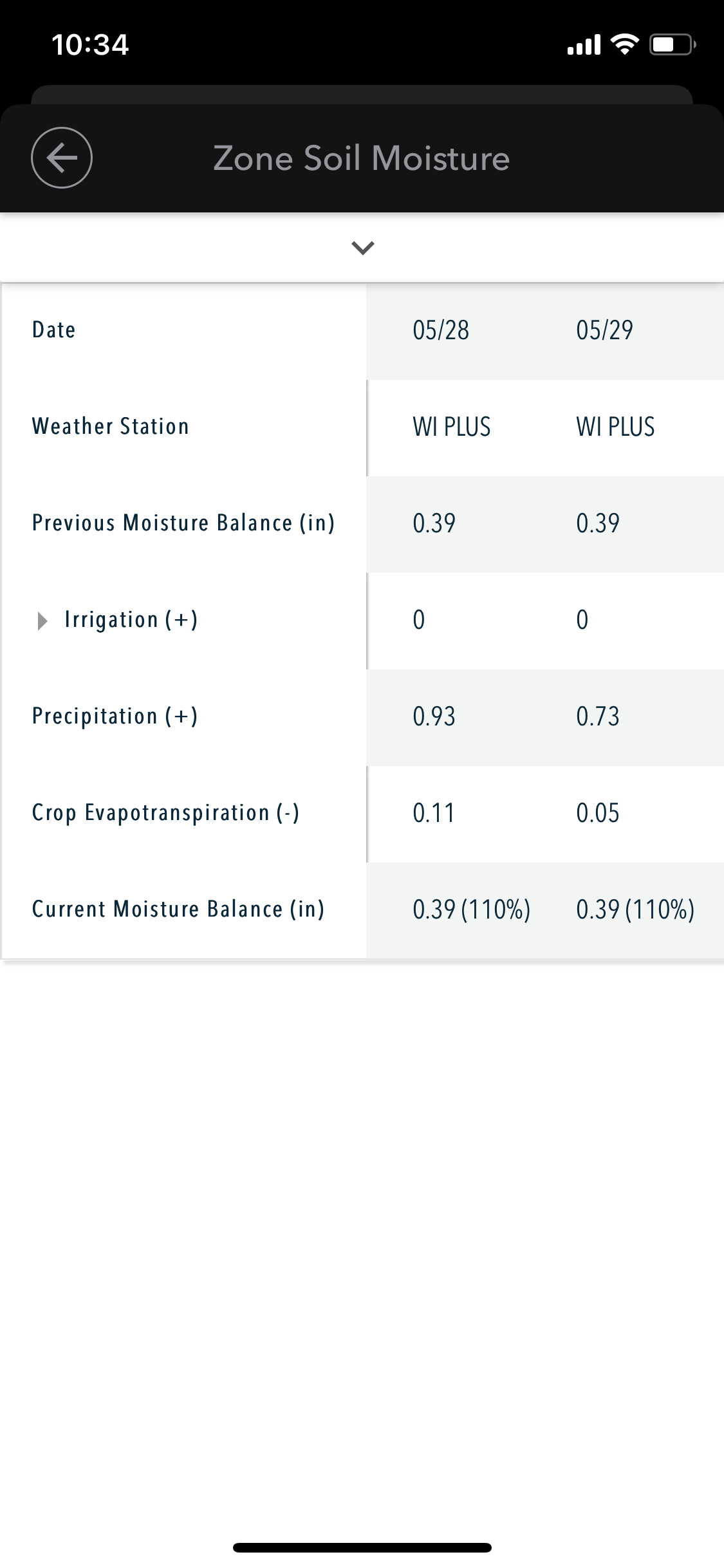
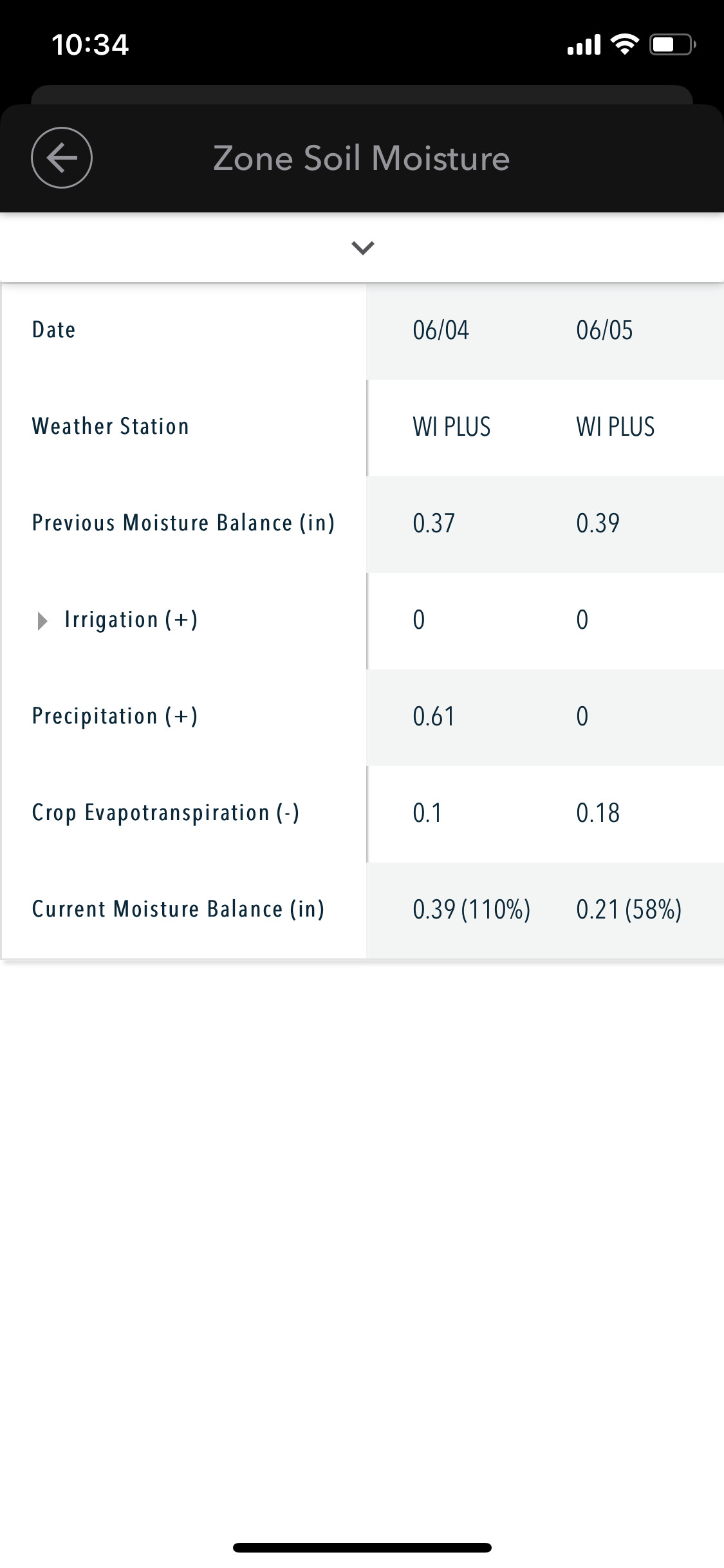
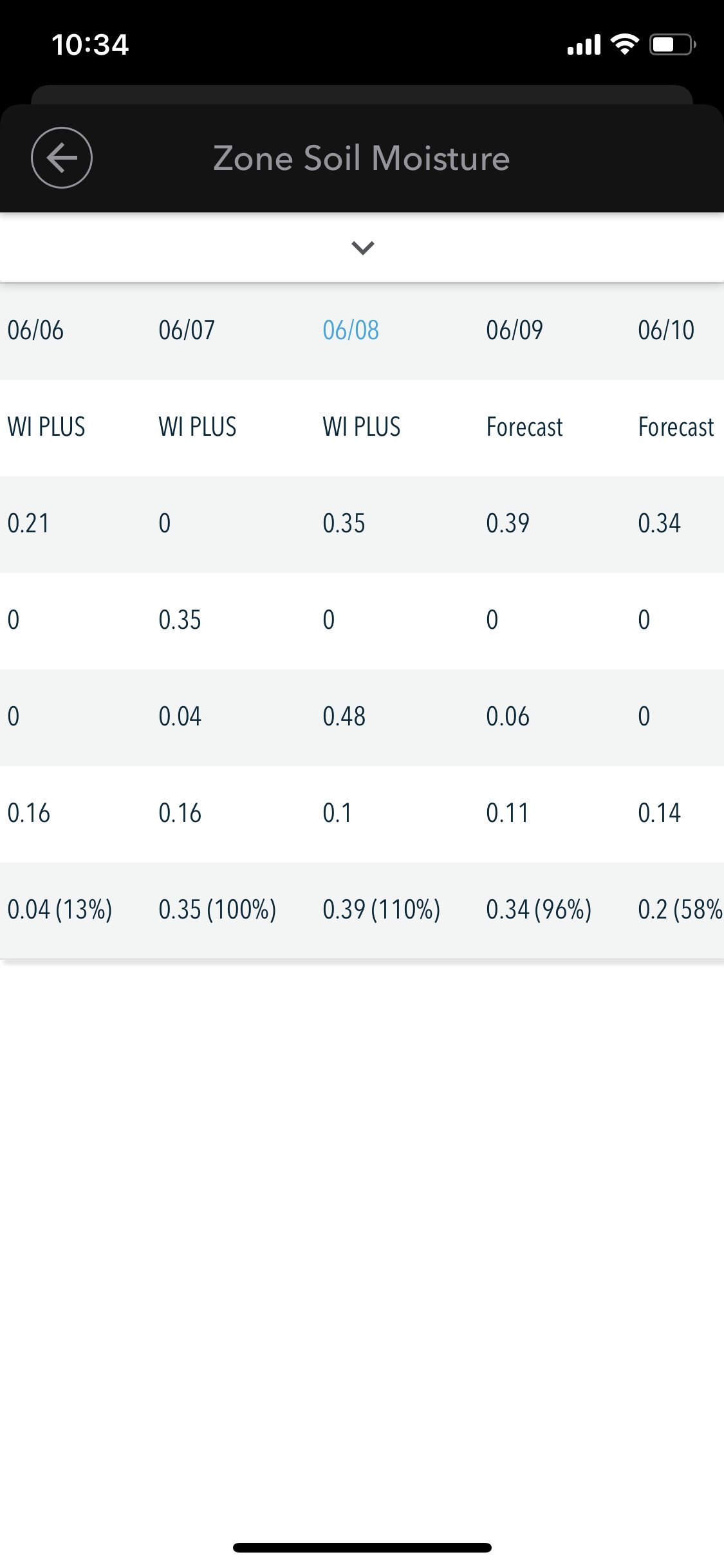
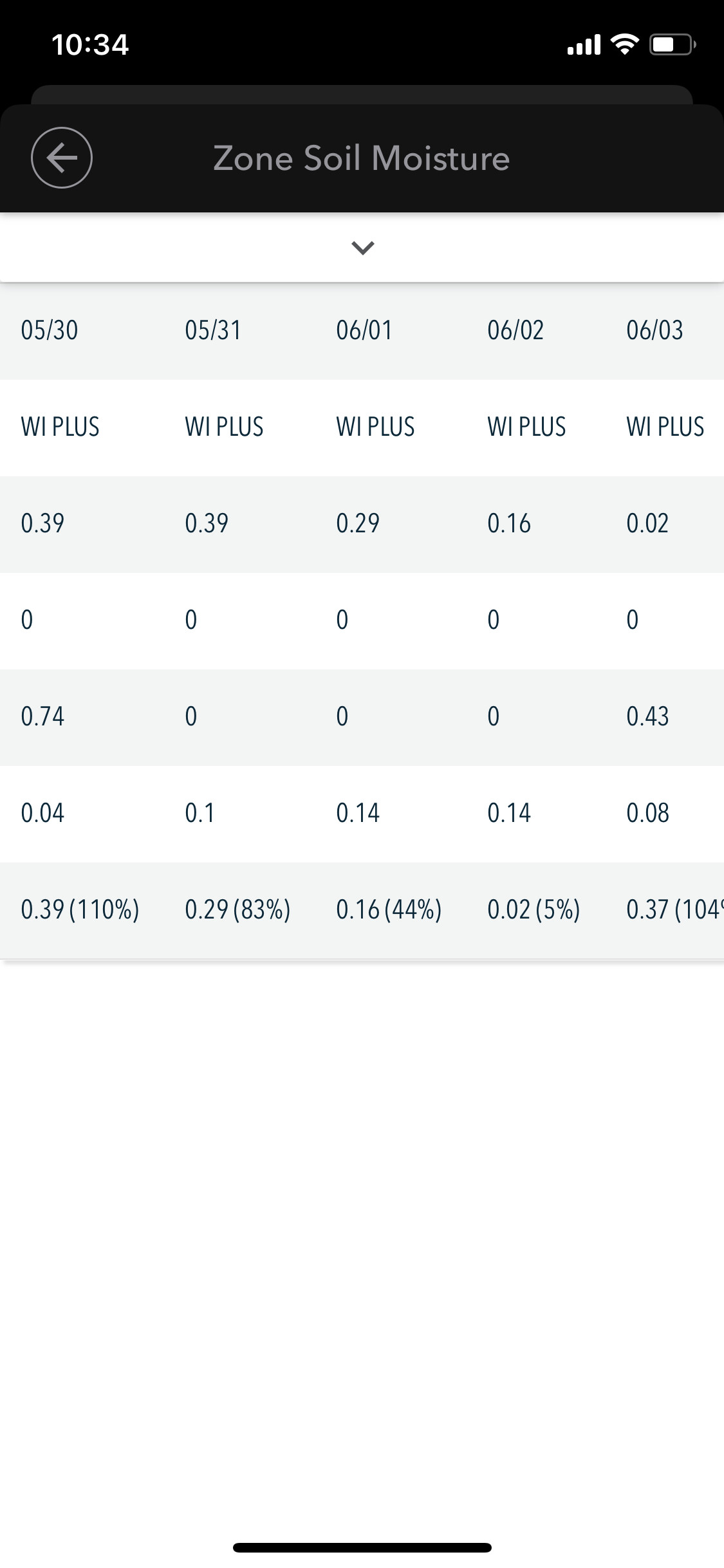
I believe it ran before the storm, storm came drop .61 of rain and when it was over the soil moisture only went up to 80% whereas I think it should have went back to 100% I then clicked fill because it was looking to irrigate again the next day.
post by rraisley on Jun 8, 2021
Filling the zone is a good idea when you know better than the controller.
Could you post a Moisture graph and table that shows this?
post by Gerardv514 on Jun 8, 2021
\ image1125×2436 209 KB](https://community.rachio.com/uploads/db1097/original/2X/6/65d97bb758ba76535bce8097a09f32afddb6dfa7.jpeg "image")
\ image1125×2436 213 KB](https://community.rachio.com/uploads/db1097/original/2X/2/2979a4d60d0fb4a617319c0cff733042f5304c3b.jpeg "image")
\ image1125×2436 139 KB](https://community.rachio.com/uploads/db1097/original/2X/6/63cd28c6e4442bdc5b99d4e55eb0cb7225b5a338.jpeg "image")
\ image1125×2436 137 KB](https://community.rachio.com/uploads/db1097/original/2X/7/7f4d989bb2cedbaee625e7d7097e08477834932d.jpeg "image")
\ image1125×2436 135 KB](https://community.rachio.com/uploads/db1097/original/2X/f/f7c46a093e5f5be691ff5a09f2689e168179bb5a.jpeg "image")
\ image1125×2436 134 KB](https://community.rachio.com/uploads/db1097/original/2X/6/614787d2730ff6e4059c0645976e870ee72509da.jpeg "image")
post by cg2000 on Jun 8, 2021
rraisley](https://community.rachio.com/t/a-beginners-guide-on-understanding-and-using-all-those-numbers/26539 "Load parent post")
Got it, thanks. There should be a toggle switch in the app between “irrigation convention” and “common sense” units. Barely any of them make much sense to me.
post by Gerardv514 on Jun 8, 2021
rraisley](https://community.rachio.com/t/a-beginners-guide-on-understanding-and-using-all-those-numbers/26539 "Load parent post")
Just read this, and this was very similar to what I was experiencing:
post by rraisley on Jun 8, 2021
Gerardv514](https://community.rachio.com/t/a-beginners-guide-on-understanding-and-using-all-those-numbers/26539 "Load parent post")
Gerardv514, the table and graph shows irrigation only occurred on 6/7 and will not irrigate again, should rain approximate what is forecast, until some time in the future. In fact, 6/7 was the only day irrigation occurred, as you got rain on 5/30, 6/3 and 6/4. On 6/7, if it didn’t water, moisture would be below 0%, so that’s correct. A little rain is forecast for 6/9, but if you get no more rain than that, it should probably water again on 6/12.
2 things: You mention your Flex Daily schedule is set to water 4 times next week. Do you mean it’s /allowed/ to water 4 times next week, or that you see it on the schedule? You didn’t post that chart/graph, but based on this week’s average ET of 0.136", I would expect it to water the 0.35" of water every 2.58 days, or every 2-3 days. Of course, next week’s temperatures might be higher, resulting in watering more often. Also, if you’re only allowing Flex Daily to water on 4 days a week (not sure if you are), that can limit its performance somewhat. Always allow it to water as many days as possible.
Second, I notice you’re using Weather Intelligence Plus, rather than a local PWS (Personal Weather Station). The weather reported will be the same, but the rain reported will be different. You may find a local PWS nearer you gives rainfall values more consistent with your location.
post by rraisley on Jun 8, 2021
FYI, this post is by someone in Europe trying to tell Rachio it’s using a US weather station (as info for Flex Daily is not available outside US/CND), so results or symptoms there may not be typical.
post by Gerardv514 on Jun 9, 2021
I think I had saw that it was about to irrigate again and then I initated a skip, since the ground was so wet.
I’m allowed to water all days, I saw 4x’s a week in the calendar (schedule). I also noted temperatures were only in the 70’s, so the summer heat of 90’s hasn’t even set in yet.
Evidence that the lawn is getting a bit much water (although mostly due to rain) is mushrooms popping up in the lawn.
So i did notice a difference when we had that big rain storm. WIP (Weather intelligence plus) was stating we had .1 of water (i cant recall exact amount so this is an example). I knew it rained a lot more than that so I changed it to a local weather station and the amount of rain stated it was .9 (again another example but it was pretty drastic). For now I set it back to WIP, should I use a local one instead? There is one a block over from me.
post by Linn on Jun 9, 2021
Yes, use a local PWS. Just take a look at it and make sure that it appears to be recording precipitation correctly.
post by Linn on Jun 9, 2021
Unless all your zones are EXACTLY identical, they may water on different days.
post by rraisley on Jun 9, 2021
As you’ve seen, rainfall can vary quite a bit, so I would choose the weather station closest to you.
post by Gerardv514 on Jun 9, 2021
Linn](https://community.rachio.com/t/a-beginners-guide-on-understanding-and-using-all-those-numbers/26539 "Load parent post")
I have 2 in my area, one is .14 miles away and the other is .51 miles away. In between the two, the one that is a bit further away appears to report a bit more data such as the UV and solar radiation. Should I still go with the closest one, or use the one reporting most data?
post by Gerardv514 on Jun 9, 2021
Linn](https://community.rachio.com/t/a-beginners-guide-on-understanding-and-using-all-those-numbers/26539 "Load parent post")
Yes, this I am aware of. Just didn’t make sense why zone 4 (example) was doing every other day (resulting in 4 irrigation for the week) despite all the rain we recently received and only about 70 degree temps, also in a some shaded zone.
post by rraisley on Jun 9, 2021
The only data used from local weather stations is the rainfall, so just choose one that seems to be reliable and has rainfall similar to yours. Other weather conditions, such as humidity and temperature, are used for your general area, and are not obtained from the PWS.
post by Gerardv514 on Jun 9, 2021
Thank you all.
post by Gerardv514 on Jun 10, 2021
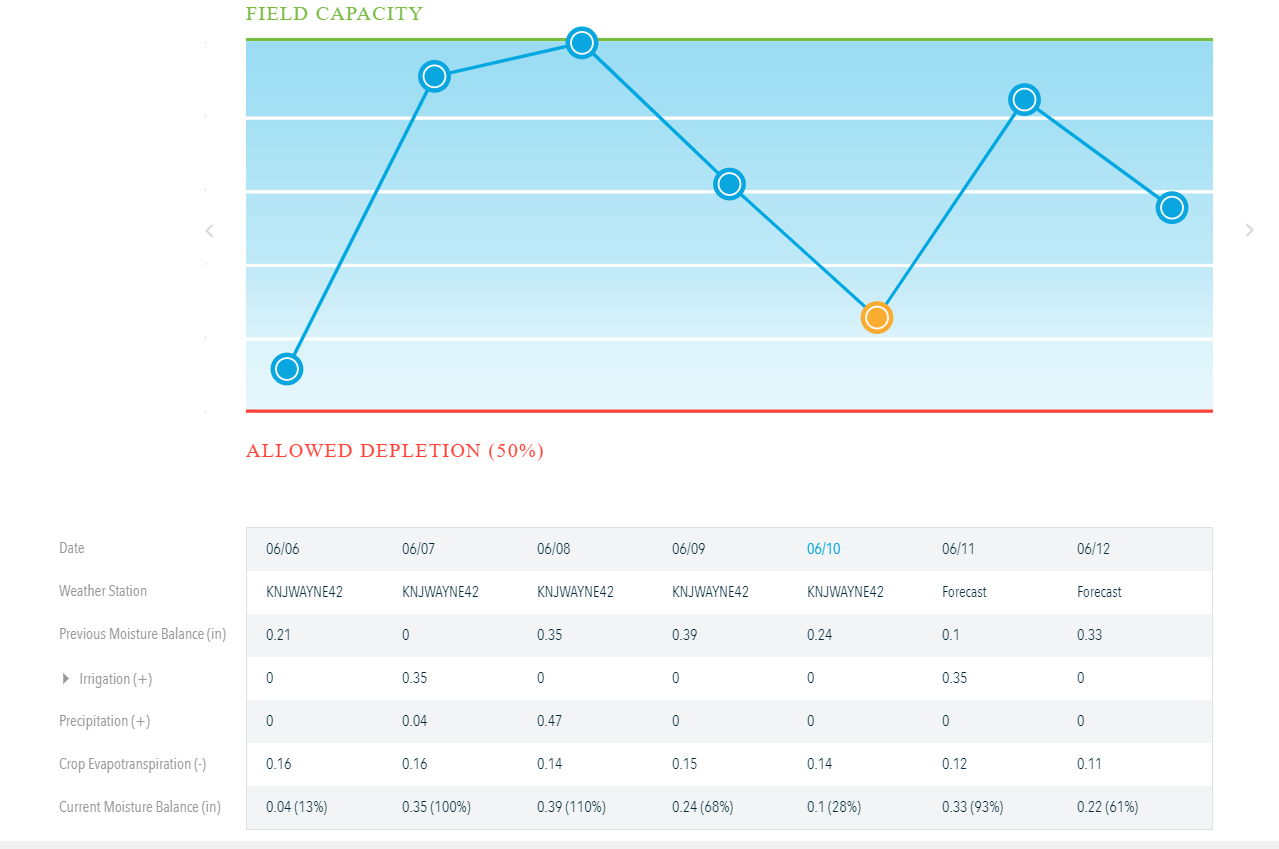
Is it normal that the ‘bucket’ on flex daily doesn’t fill all the way when the system irrigates; as indicated for tomorrow 6/11?
\ image1279×849 44.6 KB](https://community.rachio.com/uploads/db1097/original/2X/7/7a93b4f90f1edf58b938c9feb2505a0fcba0e9bf.png "image")
post by NCSuggs on Jun 10, 2021
Yes. I’ve seen that as well and consider this normal
post by Gerardv514 on Jun 10, 2021
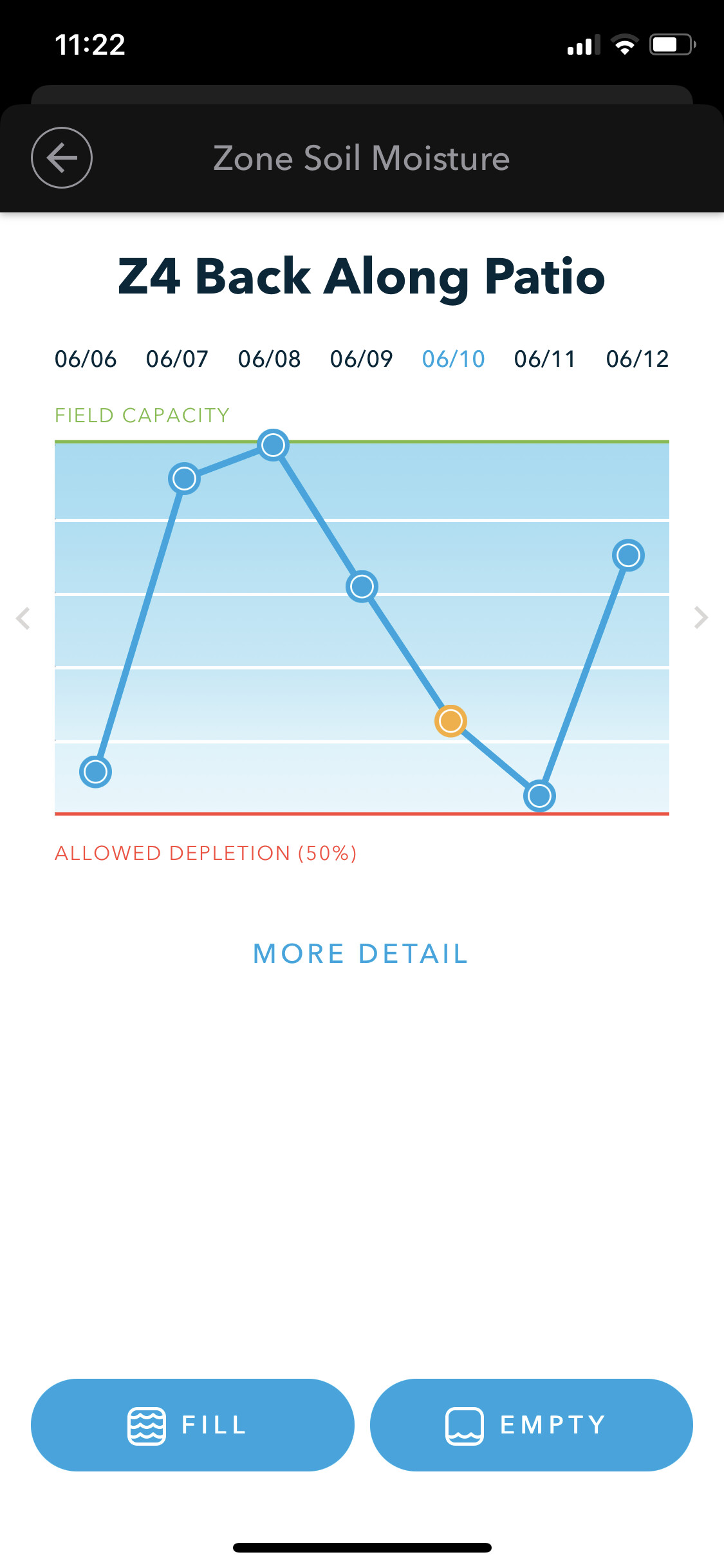
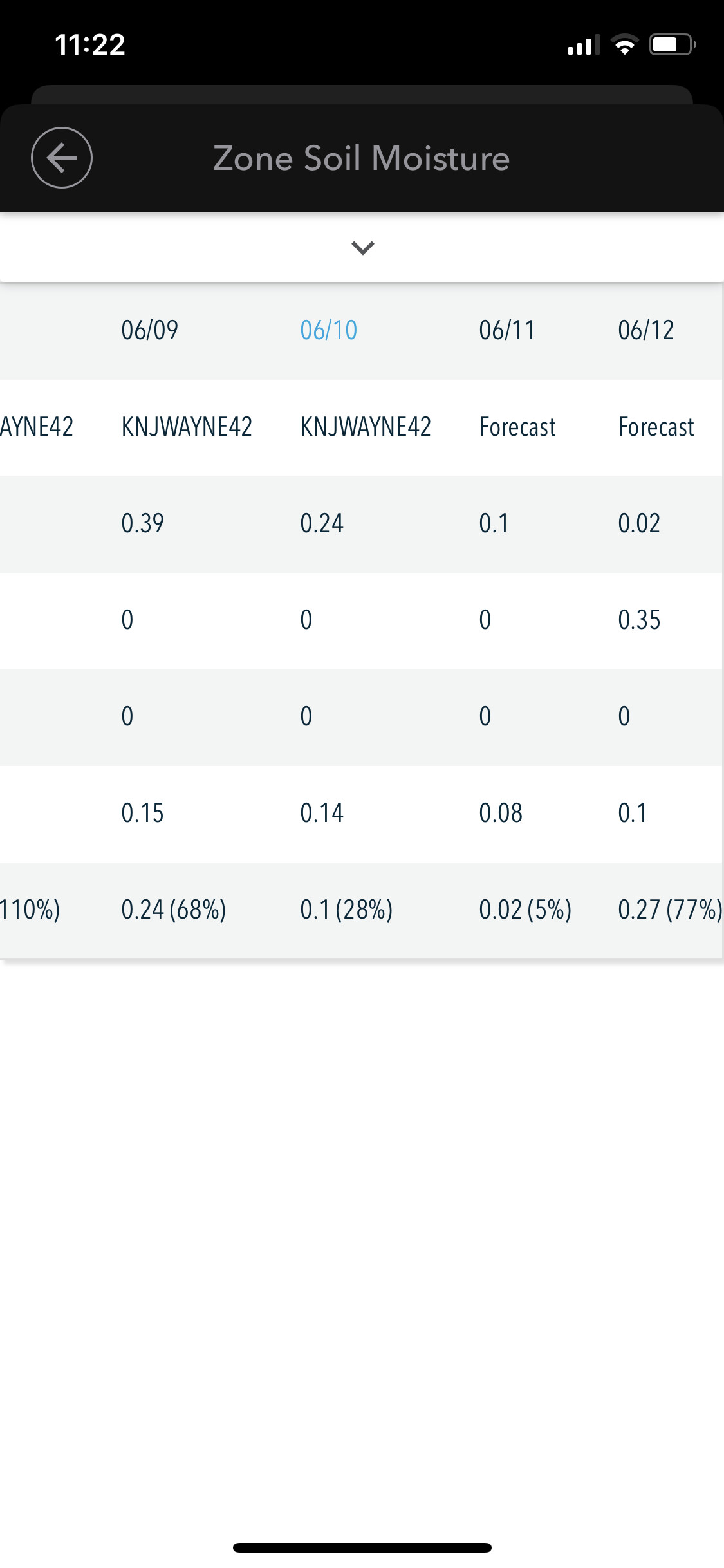
3 of my 7 zones will irrigate tomorrow. Those (the front) are at a 17% soil moisture level. The back 4 zones are at 28% soil moisture but won’t irrigate till Sunday. What’s the difference considering both are below the 50 depletion.
\ image1125×2436 191 KB](https://community.rachio.com/uploads/db1097/original/2X/0/0e26ae5fd9a916f8e4957eb9dc145c5f3789cb58.jpeg "image")
\ image1125×2436 130 KB](https://community.rachio.com/uploads/db1097/original/2X/d/d20fe56b31e4a5c3f87eb47fd4e5a3cef6e53326.jpeg "image")
post by rraisley on Jun 10, 2021
That will ALWAYS be the case. The calculated amount that Rachio puts down, unless manually changed, is exactly equal to the Allowed Depletion value. However, the ET for the day will always deduct from that, so the normal highest it would be is the irrigation amount minus the ET amount.
post by rraisley on Jun 10, 2021
Neither is getting below 50% depletion, which is at the bottom of the line. One zone /would/ go below 50% (0% moisture) on the 11th, the other on the 12th, so they both each water on those days.
post by Gerardv514 on Jun 10, 2021
1
Ah so 0% soil moisture is 50% depletion?
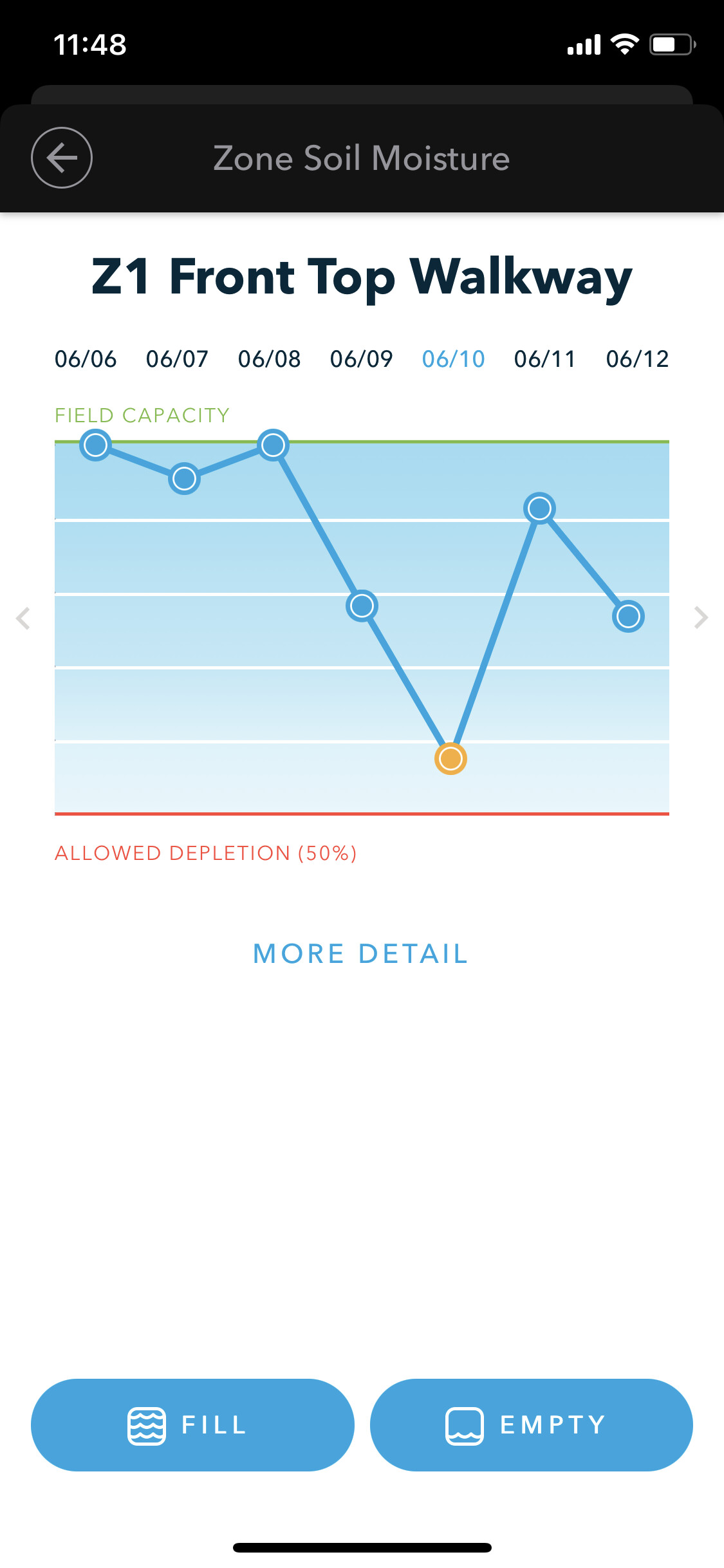
Here is the front zone, which will water tomorrow.
I would have thought the back would of irrigated at the same time considering it’s showing depleted more on the line chart?
\ image1125×2436 189 KB](https://community.rachio.com/uploads/db1097/original/2X/8/84462d4de75b84a423af2855a92f772df9873299.jpeg "image")
\ image1125×2436 131 KB](https://community.rachio.com/uploads/db1097/original/2X/a/ac387a89f4c5b4f4db33cc4b70075fac7e54152b.jpeg "image")

post by rraisley on Jun 11, 2021
It’s confusing. The terminology is confusing, and then the graph seems to contradict that.
Let’s say 100% moisture is a fully saturated area, from the surface down to the bottom of the roots. We want to water half of that value, normally, so when the /actual/ moisture gets to 50% we want to water. This is considered to be 50% Allowed Depletion (50% off of the full 100%). And the default value of 50% makes this more confusing. If it’s only 40% depletion, then when moisture gets to 60%, we would water.
Unfortunately, Rachio’s graphs and tables show only the Allowed Depletion value, normally 50%. When it’s full, it’s 100%, but when the moisture in the graph reaches the 50% allowed depletion, and it’s therefore time to water, the chart reads 0% instead. So the chart always reads the percent of the Allowed Depletion that is left. At 70% actual moisture, there is 20% of the allowed 50% left, so it reads 40% moisture. And if that doesn’t confuse you, you’re a better person than me!
The main thing is to consider the chart as FULL when it’s at the top, and TIME TO WATER when it reaches the bottom.
The Front, today, is at 17% (0.06" water left). Tomorrow, without watering, it would go to 0.06" minus the ET of 0.09" or -.03" (although Rachio never shows below zero - although I think they should). This triggers watering to occur tomorrow, as without it, it would be below zero.
For the Back, today, it is at 28% (0.10"). Tomorrow, without watering, it would go to 0.10" minus the ET of 0.08" or 0.02" (5%), so still above zero, so no watering occurs. The next day it would drop to 0.02" minus the ET of 0.1 or -0.08, below zero, so watering will occur.
It seems to be working correctly.
post by Gerardv514 on Jun 11, 2021
1
Makes sense. Thanks for the insight.
post by Linn on Jun 11, 2021
Just FYI, even though I’m normally a visually oriented person, I normally totally ignore the Rachio graphs and just look at the detail data. It makes a lot more sense to my mind. The graphs just bring up too many questions.
post by Gerardv514 on Jun 12, 2021
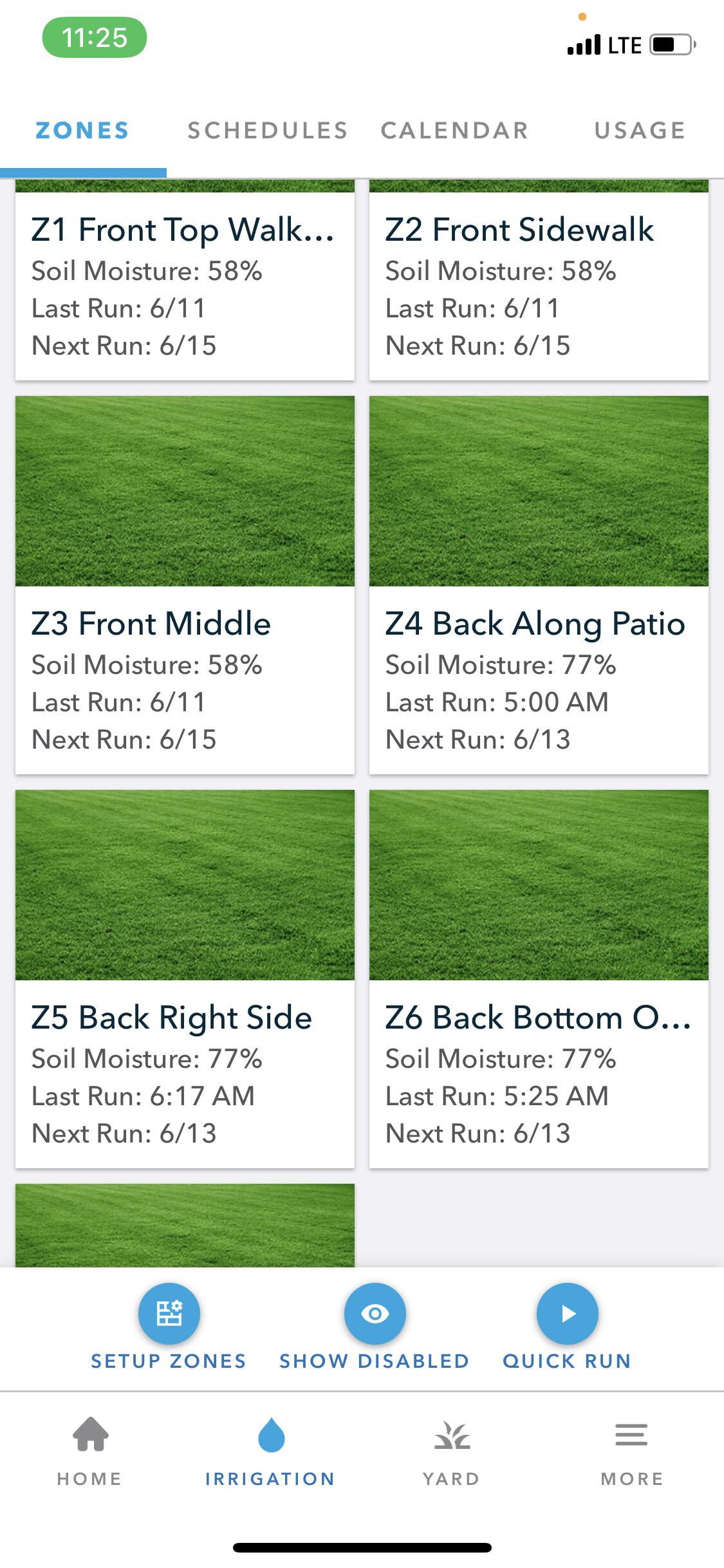
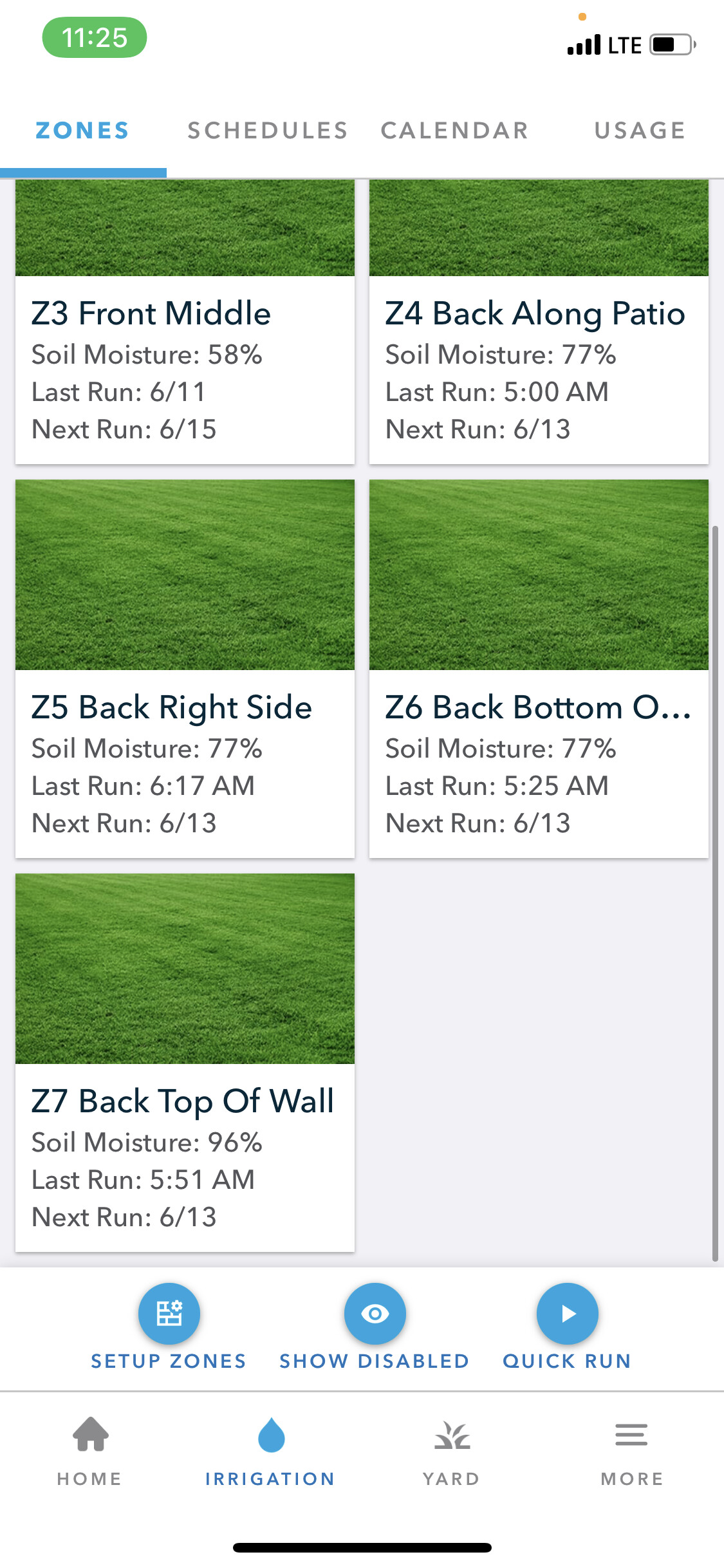
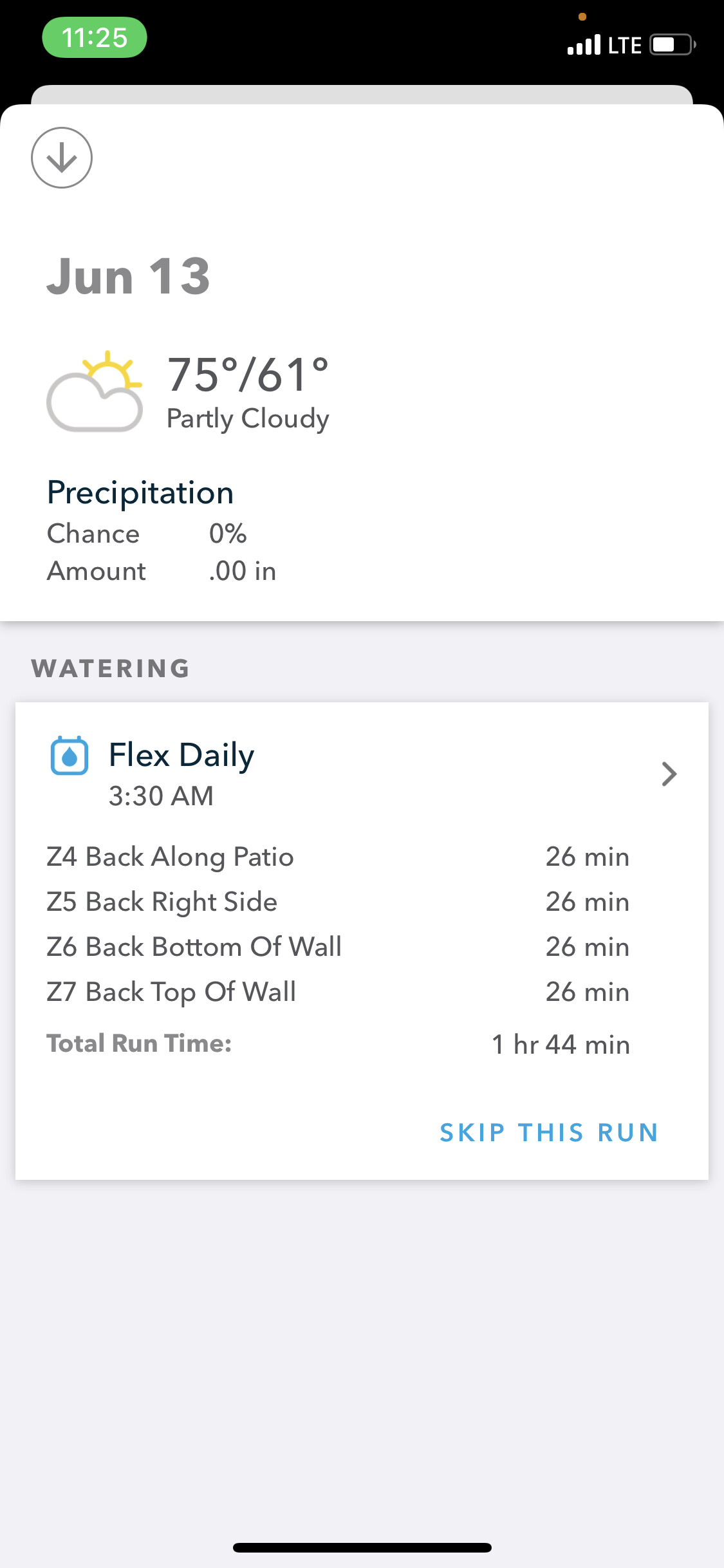
This isn’t making sense to me. Today zones 4-7 irrigated (back yard some shaded to shade) at 5 am, yesterday z 1-3 irrigated (front full sun).
Currently the moisture levels in the front are lower than the back, as should be because the back was just irrigated this morning. Our weather yesterday was overcast and rain, today is overcast 67 degrees.
On the calendar view it’s showing that zones 4-7 are going to irrigate again tomorrow, two days back to back? Z7 my mostly shaded area, which is 96% soil moist is going to irrigate again.
Why would the back zones irrigate back to back like this, compared to the front which is less soil moisture at the moment and gets a ton more sun?
\ image1125×2436 533 KB](https://community.rachio.com/uploads/db1097/original/2X/e/e7e3f84efaa5ecbc21833a8f827ef70cbf3ddfdf.jpeg "image")
\ image1125×2436 488 KB](https://community.rachio.com/uploads/db1097/original/2X/4/47a8237bcd056831da762ea321d3f362f8876aab.jpeg "image")
\ image1125×2436 141 KB](https://community.rachio.com/uploads/db1097/original/2X/c/cef7519634ff1465d3ee62a58b7a6161a6265db4.jpeg "image")

\ image1125×2436 149 KB](https://community.rachio.com/uploads/db1097/original/2X/b/bb2ea0a03dd81730692de5e0fed87116e427d4fa.jpeg "image")
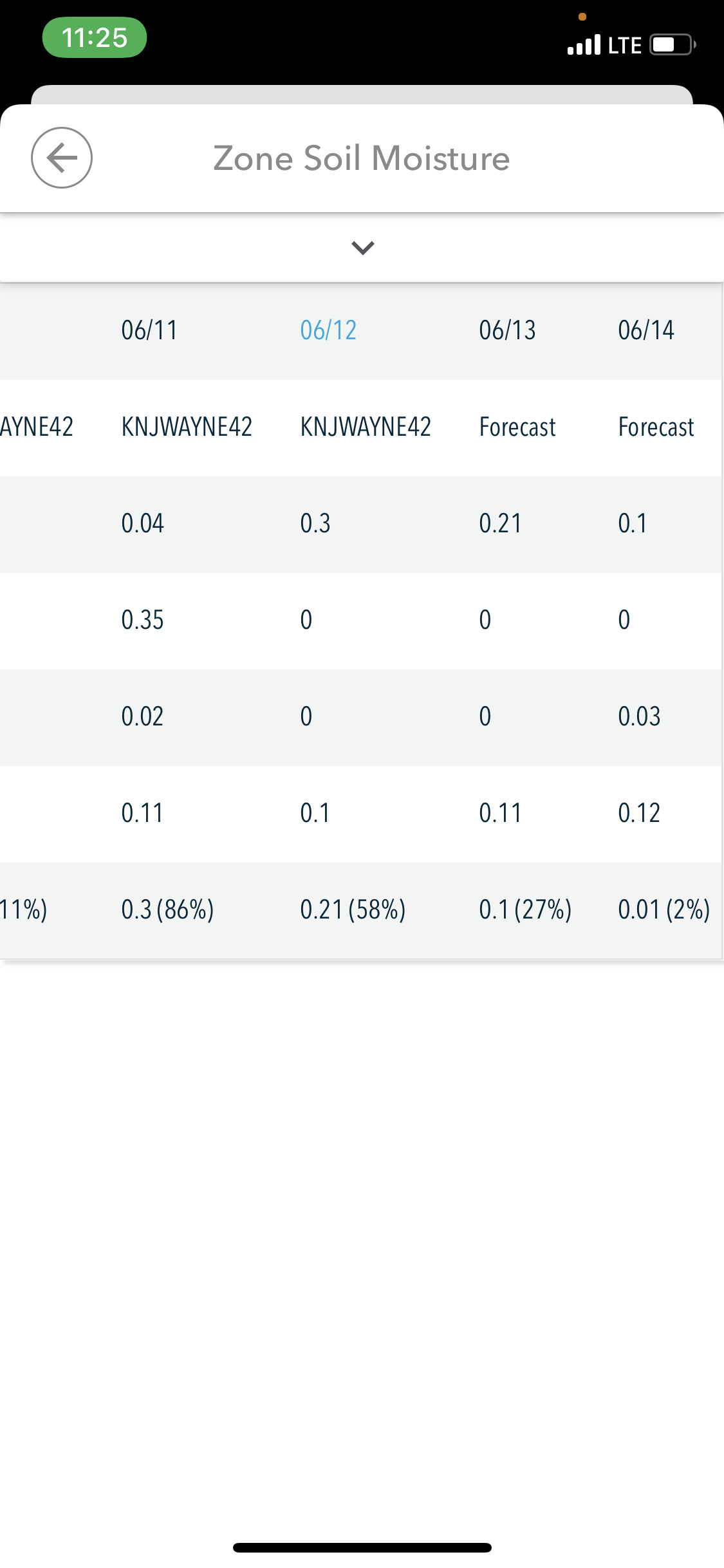
Front yard z3 chart 58% soil moisture:
\ image1125×2436 133 KB](https://community.rachio.com/uploads/db1097/original/2X/3/33a653db93785938c3c63c8a269856cb05aecc26.jpeg "image")
Rear yard z7 chart 96% soil moisture:
\ image1125×2436 136 KB](https://community.rachio.com/uploads/db1097/original/2X/b/ba2e2d1dfa8b0b823d3d06d0c41291ce627adc97.jpeg "image")

post by rraisley on Jun 12, 2021
While the zone does say it will water tomorrow, the Z7 chart indicates it won’t water until at least 6/15, 3 days from now, and that seems about right.
I think I have seen the same thing, where the zone says when an upcoming watering will occur, but the chart, graph and actual operation differ. Perhaps someone else knows why they might be different?
post by Linn on Jun 12, 2021
Gerardv514](https://community.rachio.com/t/a-beginners-guide-on-understanding-and-using-all-those-numbers/26539 "Load parent post")
I no longer trust the the overview of zones for seeing the days that a zone is going to water. I used to think that doing a refresh of that view would fix it, but not so. Just checked mine using the web interface (refreshed it first), and by the 3rd zone, it already isn’t right. The overview says it’s going to water on the 15th, but the moisture details says it’s going to water on the 14th. And based on observations, I trust the moisture details.
post by Gerardv514 on Jun 12, 2021
It has now updated, and all zones will water again on the Tuesday the 15th. I guess everything looks like it’s running as it should, just got to have confidence now and let it do it’s thing.
10 days later
post by Gerardv514 on Jun 23, 2021
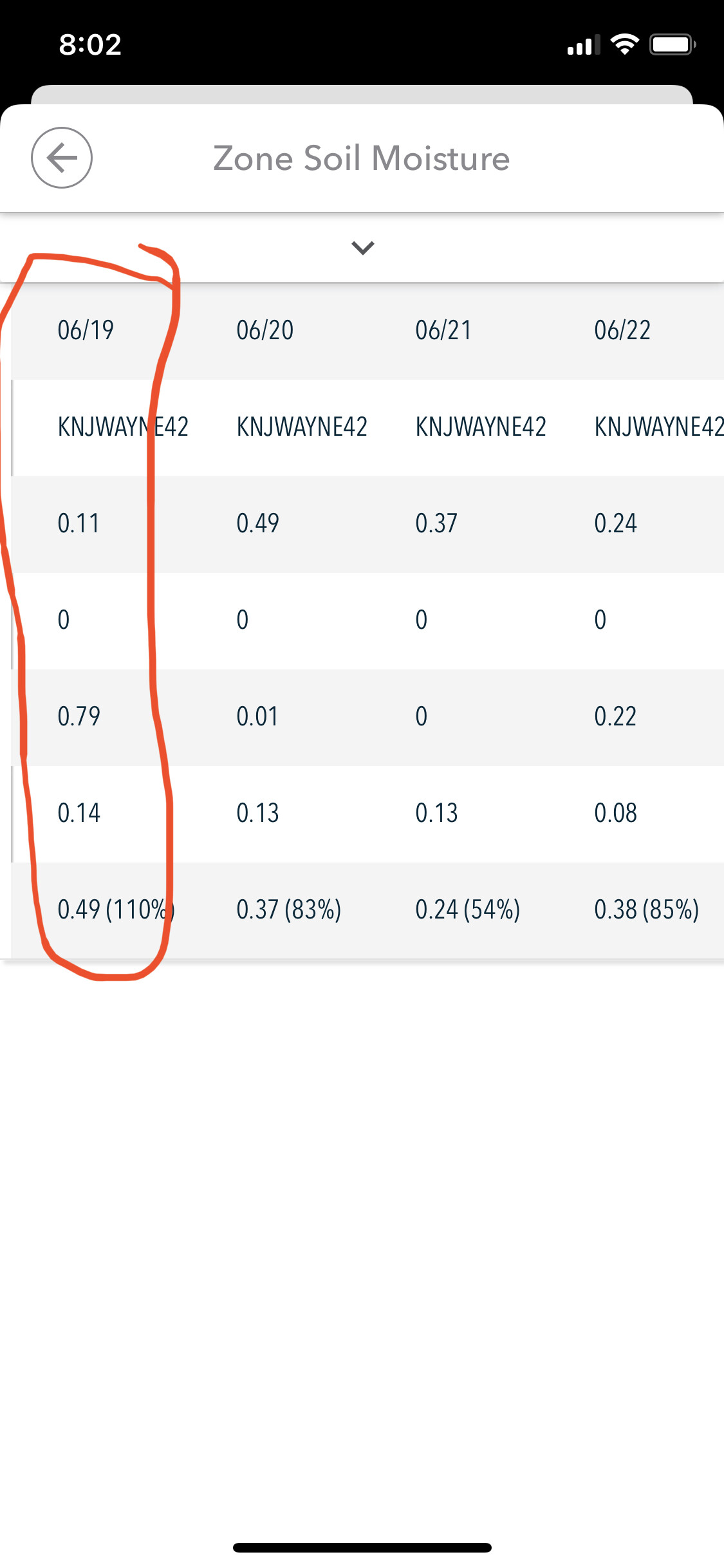
What would cause these calculations to not add up right?
\ image1125×2436 161 KB](https://community.rachio.com/uploads/db1097/original/2X/0/0ddda8e9ebb47b80ebbcbb0abd34297c701a3d95.jpeg "image")
post by rraisley on Jun 23, 2021
They don’t add up because of excessive rain. Rain over and above resulting in a moisture value of 110% is not considered. That is, the maximum moisture can be 110%, which results in your case to 0.49" of water. Anything over that will not change it, as the rain is assumed to just run off.
post by Gerardv514 on Jun 23, 2021
So it appears when I use local weather stations in my area, the rain precipitation is under reported compared to the local weather network. I know it was recommended to use the local weather station, but curious on why weather network wouldn’t be better? Doesn’t this use more data points (locations) to better average? Wouldn’t it gather from the local weather stations anyway?
post by rraisley on Jun 23, 2021
That’s the problem, it will use an average. Unless you have an average amount of rain, it won’t be right. I’m sure you’ve seen weather forecasts where rainfall for a day varies by a factor of 2 or 3 between areas only 5 miles or so apart. You want a station that gets as close to the amount of rainfall your location gets, normally the closest one.
11 days later
post by Gerardv514 on Jul 4, 2021
If it took approximately 30 mins for my sprinklers to put down a half inch of water, can I assume that my nozzle inches should be 1 inch per hour?
post by rraisley on Jul 4, 2021
1
Yes, you can.
15 days later
post by Pelusa40 on Jul 20, 2021
cg2000](https://community.rachio.com/t/a-beginners-guide-on-understanding-and-using-all-those-numbers/26539 "Load parent post")
Soil moisture and allowed depletion are inversely proportional related.
1 year later
post by bubs3141 on Sep 13, 2022
So when I did a catch cup test it said I was putting down .21 in/hr so I would need to water a ton!!. They are 1.5 gpm nozzles. My well only produces 6 gpm which is why my nozzles have to match.
post by tmcgahey on Sep 13, 2022
That low of a precip rate and that high of a GPM, must be long throw rotors?
post by bubs3141 on Sep 14, 2022
Rainbird 5000
2 years later
post by only6foot6 on Sep 3, 2024
@rraisley - I know this post is several years old but wanted to say thank you for your detailed thoughts on proper watering setup. I have spent so much time calibrating, configuring, doing catch cup tests (so many times over the years), root measuring, mason jar testing, changing my monthly crop coefficient numbers, etc…. and my lawn still turns brownish in the summer. I have tall fescue and I know the Southern California summers are brutal but I was so focused on everything being accurate and assumed the system would water correctly.
I have always had a hard time justifying changing one of my controller’s variables to make my system water longer when I knew they were all setup correctly. I know how much water my zones put down. I know my soil type. I know my root depth. I know my lawn type, etc….
Your recommendation of changing the crop coefficient is genius. It made me rethink things. I have always assumed the 12 month crop coefficient recommendations that are on the internet were accurate. I guess they are more a guideline and they could be wrong. So I took your recommendation and bumped up the recommended number for September by 10%. Time will tell and it might be too late for this summer but thanks for pushing me outside of the box.
post by Chromedome on Sep 4, 2024
After years of struggling I’m done. It seems in the North Phoenix area, there’s nothing I can do to get my soil type correct and get the flex daily to water correctly. I now have it set to manually water every 3 days during the summer using locally recommended amount of inches per week. I’ve tried at least four different sources to figure out the soil type and they can’t seem to agree. I put my soil in jars and that was even fairly inconclusive. It’s very frustrating. This particular variable is perhaps the most important but it’s just a big stupid guess in reality.
post by rraisley on Sep 4, 2024
I don’t think soil type is as important as you/they think. All it really determines is how much water your root depth of soil will hold at one time (Available Water). If it’s set too high, water will run off and not benefit the lawn. You should be able to notice that in puddling and runoff. If it’s set too low, it will require watering more often, resulting in more shallow roots but but it shouldn’t affect the grass that much. Reducing or increasing Available Water is exactly the same as increasing or decreasing Allowed Depletion. Together they all just determine how how your lawn is watered.
If you want/need MORE water to be applied to your lawn (i.e. it starts to wilt in hot weather), then none of those factors will help. Increase the Crop Coefficient to make the program apply more water over time. And be sure you have an accurate value for Nozzle Inches per Hour, either by measuring with catch cups or actual water usage over actual zone area. That is critical IMHO, and something many people don’t bother with. And shouldn’t have to, but it is what it is.
post by tmcgahey on Sep 4, 2024
Chromedome](https://community.rachio.com/t/a-beginners-guide-on-understanding-and-using-all-those-numbers/26539 "Load parent post")
I’m in AZ as well, and while my grass and vegetation looks solid (considering), the summers here are brutal and there is borderline no amount of water you can put down to keep things lush when we have 100+ days of 100+ temps. I heard on the radio yesterday that the average temp this summer was 99 degrees. I have some bushes that just cannot handle the heat and are struggling big time, but they will come back. I have tops of citrus and Ficus trees that are physically burnt. No amount of water will keep that from happening.
But, all in all, my yard looks better than all my neighbors yards…
post by Chromedome on Sep 4, 2024
1
If I remember correctly, it was watering too much and too frequently, like I think every two days or something. Every other setting was correct and so I don’t understand why it was doing that. I’m manually putting down about 1.9 in per week and my lawn looks great.
After years of research I think I had settled on manually inputting 0.17 AWC. I think my reply will be unclear if I don’t explain that this was what I used to be doing when trying to get the flex daily working but again, I now just water every 3 days putting down about .75 in each time.
For a couple weeks I tried about 1.65 in and I don’t think that was enough. It’s been a crazy hot summer here in Phoenix.
Reply
New & Unread Topics
Topic list, column headers with buttons are sortable.
Want to read more? Browse other topics in Getting Started or view latest topics.
Invalid date
Invalid date
Loading complete